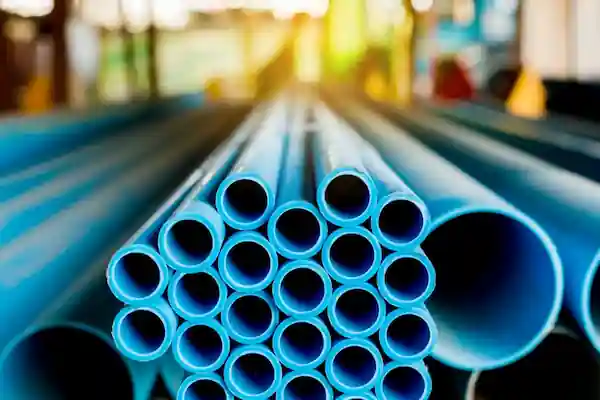
Polyvinyl Chloride (PVC)
Polyvinyl Chloride (PVC) is an important material in the plastics industry thanks to its durable structure, processability and broad range of applications. At Hür Plastik, we manage PVC recycling processes with a focus on quality, sustainability and controlled production, providing solutions tailored to the needs of different industries.
Polyvinyl Chloride (PVC), is a versatile plastic that can be produced in rigid or flexible forms and stands out for its durability and wide range of applications. PVC material can be recovered through recycling processes, contributing to both environmental sustainability and production efficiency.
What Is Polyvinyl Chloride (PVC)?
Polyvinyl Chloride (PVC) is a thermoplastic polymer widely used in the plastics industry. Its durable structure, long service life and ability to be formulated for different applications make it useful across many sectors. It covers a broad application range, from rigid products to more flexible uses.
Thanks to its recyclable structure, PVC has an important role in sustainable manufacturing. Through appropriate sorting, processing and recovery, it can be returned to the production chain and help reduce waste.
What Are the Properties of Polyvinyl Chloride (PVC)?
Polyvinyl Chloride (PVC) Has a Durable Structure
Its long service life makes it a reliable choice across many industries.
Processability
Its compatibility with different manufacturing techniques allows it to be used across a broad range of applications.
Rigid and Flexible Form Options
A versatile material that can be formulated with different physical properties according to the intended use.
Recyclable
An important plastic material that can be recovered for reuse through appropriate recycling processes.
Where Is Polyvinyl Chloride (PVC) Used?
Polyvinyl Chloride (PVC) is used across many industries thanks to its durability and manufacturing flexibility. Applications vary according to product form and intended use, but it is commonly preferred in areas such as:
Why Is Polyvinyl Chloride (PVC) Recycling Important?
PVC recycling is an important process, particularly for returning durable plastic waste to the economy. After appropriate collection, sorting and processing, PVC material can be recovered for use in new production. This helps reduce waste released into the environment and supports more efficient use of resources.
At Hür Plastik, we follow an approach to PVC recycling that combines quality, production continuity and environmental responsibility. We consider recycling not only a technical operation, but also an important part of sustainable manufacturing.
Why Choose Hür Plastik for Polyvinyl Chloride (PVC)?
With its experience in plastics recycling, production infrastructure and quality-focused approach, Hür Plastik provides reliable solutions for PVC recycling processes. Through controlled production, planned process management and an approach aligned with industry needs, we aim to provide our business partners with sustainable service.
Contact us for detailed information about Polyvinyl Chloride (PVC) products and recycling processes.
What Information Should Be Checked When Purchasing PVC Granules?
When purchasing PVC granules, the term “PVC” alone is not technically sufficient. Polyvinyl chloride can be formulated as rigid, semi-rigid or plasticised flexible compounds. Stabilizers, plasticisers, fillers, pigments and other additives can also significantly change processing behaviour and end-use performance. The buyer should therefore first define the required hardness/flexibility level, manufacturing process, colour expectations and critical technical requirements of the target product.
For rigid PVC, ISO 21306-1:2019, considers base-polymer parameters, intended use, processing method, additives, colorants, fillers and reinforcing materials, as well as properties such as Vicat softening temperature, notched Charpy impact strength and modulus of elasticity, when classifying PVC-U moulding and extrusion materials. This approach shows why two products offered under the same “PVC” name may not be equivalent for every application.
Why Is the Difference Between PVC-U and PVC-P Critical in Purchasing?
PVC-U refers to unplasticised, more rigid PVC materials. PVC compounds used in pipes, profiles and various rigid construction applications may fall within this group. PVC-P is plasticised PVC and includes formulations used where flexibility is required, such as cables, hoses, films and other soft products. Although both belong to the same polymer family, their technical classifications and test criteria are not the same.
While ISO 21306-1:2019 is used as a classification system for PVC-U, plasticised PVC has a separate system defined by ISO 24023-1:2020 . ISO 24023-1 considers physical form, intended use, processing method, additives and colorants, as well as properties such as Shore hardness, density and a specified torsional-stiffness temperature for PVC-P materials.
For this reason, rather than requesting only “PVC granules”, a purchasing specification should state, where possible, PVC-U or PVC-P, the target hardness/flexibility level, process, colour and final application. Because Hür Plastik’s current product page describes the PVC family in general, the availability of a particular rigid or flexible grade should be verified separately.
How Do Plasticisers, Fillers and Additives Change PVC Raw Material?
One of PVC’s important industrial characteristics is that it can be formulated across a broad range of properties. Plasticisers may be used to increase flexibility, while mineral fillers, heat stabilizers, pigments and other additives can affect processing, appearance and performance. For recycled PVC, knowing only the polymer identity is therefore not always enough to predict final-product behaviour.
Especially with recycled material, the formulation of the previous product becomes important. PVC waste from different sources such as profiles, pipes, cables or flexible film may not contain the same additive system. Controlled sorting of source material is therefore a critical purchasing criterion for both process stability and final-product consistency.
VinylPlus’s current supplier-certification approach also treats transparency, traceability and responsible use of additives as separate assessment topics for PVC additives and compounds. This does not imply a Hür Plastik certification; it is an industry example illustrating why formulation information matters in the PVC supply chain.
What Do Vicat, Shore Hardness and Density Tell You?
Which parameter is most important in the technical evaluation of PVC depends on the material type. For rigid PVC-U products, criteria such as Vicat softening temperature, impact behaviour and modulus of elasticity may be important. For flexible PVC-P products, parameters such as Shore hardness and density may be more relevant when comparing grades.
It is therefore not appropriate to use the same technical checklist for rigid and flexible PVC. Test method, specimen-preparation conditions and conditioning can also affect the results. For PVC-U, ISO 21306-2:2019, and for PVC-P, ISO 24023-2:2020 define the relevant methods for specimen preparation, processing of test material and determination of properties.
| Control Item | Why Does It Matter in Purchasing? |
|---|---|
| PVC type | To distinguish PVC-U, PVC-P and other compound structures |
| Hardness / flexibility | To evaluate compatibility with the mechanical and end-use requirements of the target product |
| Vicat / thermal behaviour | To compare grade-specific temperature behaviour, especially in rigid PVC applications |
| Density | To help evaluate formulation and batch consistency |
| Additive / filler structure | To understand the composition affecting processing and final-product performance |
| Colour and source | To control appearance and batch consistency in recycled raw material |
How Should Recycled PVC Granules Be Evaluated?
One of the most important purchasing questions for recycled PVC is the source stream of the raw material. Material originating from rigid profiles or pipes does not have the same formulation as material from plasticised cables or flexible products. Uncontrolled mixing of different PVC formulations and non-PVC polymers can create undesirable variability in processing behaviour and final-product properties.
During supplier discussions, the product’s source type, rigid/flexible classification, colour, visible foreign-material level, any filler and additive information, and how critical technical tests are monitored should therefore be reviewed. Even recycled material with strong technical suitability may still need to be verified for a specific application; sample trials and incoming quality control are important for this reason.
For a general framework on evaluating recycled granules, see our recycled plastic granules guide .
Which Manufacturing Process Should PVC Granules Be Selected For?
The PVC family can be used in profile and pipe extrusion, cable coating, various injection-moulded products, film/sheet and other industrial applications. However, the same compound should not be assumed suitable for all these processes. Rigidity, plasticiser system, heat stabilization, filler content, flow behaviour and final-part requirements should be evaluated together when selecting a process-compatible material.
PVC is a polymer family that requires controlled processing because of its heat-sensitive processing window. Processing temperatures or machine settings should therefore not be presented as universal recommendations without verification against documentation for the specific grade from the manufacturer or supplier. The buyer’s own equipment and tooling/calibration setup also affect actual processing behaviour.
Why Should PVC Raw-Material Quality Control Be Evaluated Together With Source Information?
Because the additive system is an important part of product behaviour in PVC compounds, granule appearance alone is not sufficient. Two recycled PVC batches that look the same colour may come from different sources or formulations. As a result, hardness, density, thermal behaviour or processability may differ.
For critical production, supplier specification, sample approval and, where necessary, batch-specific analysis should be managed together. A TDS represents the general product range, while a batch-analysis certificate represents measured values for a specific production lot or delivery. Purchasing and quality teams should recognise that these documents do not serve the same purpose.
How Should PVC Granule Quotations Be Compared?
PVC quotations may contain technically different compounds under the same product name. Whether the product is PVC-U or PVC-P, its plasticiser and filler system, colour, density, hardness, source stream, level of quality control, packaging and delivery terms all affect true comparability. A decision should therefore not be based only on price per kilogram or tonne.
The purchasing team should first define the technical requirements of the target application and request quotations from all suppliers against the same product definition. For general plastic raw-material classes, see our plastic raw materials guide . For Hür Plastik’s current PVC product and supply options, use our contact page .
Frequently Asked Questions About PVC Granules
What are PVC granules?
PVC granules are the granulated form of a polyvinyl-chloride-based compound suitable for processing. The product may contain more than PVC resin alone; depending on the application, it may include stabilizers, plasticisers, fillers, pigments and other additives.
What is the main difference between PVC-U and PVC-P?
PVC-U refers to the unplasticised, more rigid PVC group, while PVC-P refers to more flexible PVC formulations containing plasticiser. These two product families do not have the same technical classifications, test criteria or applications.
Are recycled PVC and virgin PVC the same?
No. Source history, the previous additive system, thermal history and possible contamination can affect the behaviour of recycled material. Direct equivalence with virgin material should not be assumed for a specific application.
Why is density important in PVC granules?
Density is a useful technical parameter, particularly for evaluating compound formulation and batch consistency. However, it does not define quality on its own; it should be interpreted together with hardness, thermal properties, impact, additive system and target process.
Can the same PVC granules be used for pipes, profiles and cables?
Generally, no. Pipes and profiles typically require rigid-PVC characteristics, while applications such as cable may use plasticised PVC formulations. Actual suitability should be verified against the technical documentation for the grade and the final-product specification.
What are the technical values of Hür Plastik’s PVC product?
The current product page does not publish a verified table of Vicat, Shore hardness, density, impact strength or plasticiser content. For that reason, no figures are being invented on behalf of Hür Plastik. Contact Hür Plastik directly for current grades and technical information.
Share the product type and technical criteria for your PVC raw-material requirements.
Provide your target application, rigid/flexible requirement, manufacturing method, colour and quality expectations to receive current product and supply information.