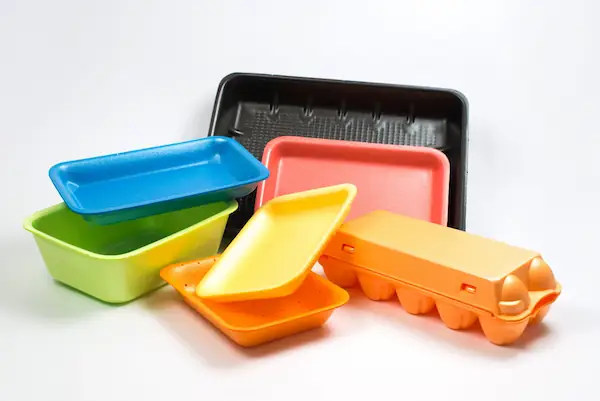
Polystyrene (PS)
Polystyrene (PS) is an important material in the plastics industry thanks to its lightweight structure, easy processability and broad range of applications. At Hür Plastik, we manage PS recycling processes with a focus on quality and sustainability, providing solutions suitable for different industries.
Polystyrene (PS), is a plastic material with a wide range of applications from packaging to industrial uses thanks to its lightweight and rigid structure. PS material can be recovered through recycling processes, providing important advantages for both environmental sustainability and production efficiency.
What Is Polystyrene (PS)?
Polystyrene (PS) is a thermoplastic polymer known for its rigid and lightweight structure. It can be produced in transparent or opaque forms and is suitable for different manufacturing techniques because it can be shaped easily. It is widely used especially in packaging, insulation and disposable products.
As a recyclable material, PS can be returned to the production chain through proper sorting and processing. This helps reduce waste and supports more efficient use of resources.
What Are the Properties of Polystyrene (PS)?
Polystyrene (PS) Has a Lightweight Structure
Its low density provides advantages in handling and use.
Easy to Process
It can be shaped readily using different manufacturing techniques.
Thermal Insulation Properties
It is especially preferred for insulation applications in foam form.
Recyclable
It can be recovered for reuse through appropriate recycling processes.
Where Is Polystyrene (PS) Used?
Polystyrene (PS) is used across many industries thanks to its manufacturing flexibility. Applications vary according to product form, but it is commonly used in areas such as:
Why Is Polystyrene (PS) Recycling Important?
Polystyrene recycling is an important process, particularly for returning packaging waste to the economy. With proper collection and sorting, PS material can be reprocessed and made suitable for reuse in manufacturing processes.
At Hür Plastik, we prioritise quality and sustainability in recycling processes and adopt a production approach that supports the recovery of PS material.
Why Choose Hür Plastik for Polystyrene (PS)?
With its experience and production capabilities in the plastics recycling industry, Hür Plastik provides reliable solutions for PS recycling processes. By focusing on quality and continuity in production, we aim to provide our business partners with a sustainable service approach.
Contact us for detailed information about Polystyrene (PS) products and recycling processes.
What Information Should Be Checked When Purchasing PS Granules?
When purchasing polystyrene, the term “PS granules” alone is not a technically sufficient product definition. The polystyrene family includes general-purpose polystyrene, impact-modified products and different material systems for foam applications. Mechanical requirements, surface appearance, process method, flow behaviour and any regulatory requirements for the final product should be evaluated together when selecting a grade.
ISO 24022-1:2020, considers intended application, processing method, significant properties, additives, colorants, fillers and reinforcing materials, as well as Vicat softening temperature and melt mass-flow rate, when classifying amorphous polystyrene homopolymers. The standard also makes clear that two materials with the same classification do not necessarily provide identical performance.
GPPS, HIPS and EPS Are Not the Same Polystyrene Product
Different product groups may be sold under the general name “polystyrene”. GPPS, or general-purpose polystyrene, may be used where transparency and rigidity are important. Impact-modified polystyrene has a different material structure and is commonly referred to as HIPS. EPS is the expandable/foam product group within the polystyrene family and should not be evaluated within the same technical framework as standard granule applications.
The scope of ISO 24022-1 includes amorphous polystyrene homopolymers and excludes expanded polystyrene and elastomer-modified impact-resistant polystyrene. For impact-resistant PS, ISO 19063-1:2015 defines a separate classification system. This distinction illustrates why writing only “PS” on a purchasing form may be insufficient.
Hür Plastik’s current product page describes polystyrene as a general product family. If you require a specific GPPS, HIPS, foam type or another grade, the product type should be stated clearly during the quotation stage.
Why Are MFR and Vicat Important for PS Granules?
Melt mass-flow rate is one of the basic quality-control indicators used to compare the flow behaviour of thermoplastic materials under specified temperature and load conditions. Thin-walled injection-moulded parts, thicker geometries and extrusion applications may require different flow behaviour. MFR should therefore be read together with the test temperature and load, not as a standalone figure.
ISO 1133-1:2022, defines standard methods for measuring MFR and MVR under specified temperature and load conditions and states that these tests are primarily used for quality control. Vicat softening temperature is also considered an important property in polystyrene classification. However, suitability for a particular application should not be reduced to MFR or Vicat alone.
| Control Item | Why Does It Matter in Purchasing? |
|---|---|
| PS type / grade | To distinguish GPPS, impact-resistant PS and other product systems |
| MFR / MFI | To compare flow behaviour for the target process under equivalent test conditions |
| Vicat | To evaluate grade-specific thermal behaviour |
| Impact performance | To verify mechanical requirements, especially for impact-resistant PS types |
| Colour and appearance | To define quality expectations for transparent, light-coloured or visible parts |
| Source / batch information | To evaluate batch consistency in recycled raw material |
How Should Colour, Purity and Contamination Be Evaluated in Recycled PS Granules?
In recycled polystyrene, granule colour and visual cleanliness may be important quality indicators, but they do not prove technical suitability on their own. Mixing with other polymers, unwanted additives, foreign matter or residues from previous use can affect processing stability and final-part properties.
Especially for products where surface appearance is critical, it is useful for the buyer to define its own acceptance criteria for colour tolerance, black specks, opacity/transparency and surface defects. A sample trial before serial production provides a more reliable basis for decision-making than granule appearance alone.
Which Application Should Recycled Polystyrene Be Selected For?
The polystyrene family is used in packaging, electronics/home-appliance components, various housings, industrial products and foam applications. However, these application areas do not mean that the same PS grade is suitable for every use. Standard polystyrene homopolymer and impact-resistant PS have different mechanical expectations, while foam products such as EPS have separate processes and product architectures.
ISO 24022-2:2020, defines methods for specimen preparation, processing and conditioning test material, and determining properties of PS moulding and extrusion materials. This shows why test methods and specimen-preparation conditions should also be checked when comparing data from different suppliers.
Can Recycled PS Automatically Be Used in Food Packaging?
No. The fact that a polymer has historically been used in food packaging does not mean that recycled PS granules are automatically suitable for food contact. Food-contact suitability depends on separate conditions such as raw-material source, recycling technology, manufacturing process, migration and applicable regulatory requirements.
In the European Union, for recycled plastics intended to come into contact with food, Commission Regulation (EU) 2022/1616 sets specific rules for recycled plastic materials and articles. Therefore, unless Hür Plastik provides an explicit food-contact suitability statement and the required documentation for a specific PS product, this page does not make a “food-grade PS” claim.
What Should Be Checked in Quality Control for PS Raw Material?
With recycled raw material, an acceptable initial sample does not guarantee the same result throughout serial production. Source material, colour distribution, the risk of foreign polymers and previous processing history may vary between batches. The buyer should therefore define critical acceptance criteria in advance.
A TDS represents the general product specification, while a batch-analysis document represents the results for a specific production lot or shipment. For critical applications, incoming quality control, sample trials and, where necessary, review of batch-specific analyses provide a more controlled purchasing process. For a broader overview of quality considerations for recycled granules, see our recycled plastic granules guide .
How Should PS Granule Quotations Be Compared?
Even if two PS granule quotations use the same product name, grade, flow behaviour, colour, impact requirements, source material, additive content, packaging and delivery terms may differ. Making a decision only on price per kilogram or tonne may therefore result in technically non-equivalent products being compared as if they were the same.
The purchasing team should first define the target process and critical acceptance criteria, then request quotations from all suppliers within the same technical framework. For general material classes, see our plastic raw materials guide . For current Hür Plastik PS product and supply information, use our contact page .
Frequently Asked Questions About PS Granules
What are PS granules?
PS granules are the granulated form of polystyrene-based raw material suitable for manufacturing processes. However, “PS” does not refer to a single grade; there may be general-purpose, impact-resistant and other polystyrene types for different applications.
What is the difference between GPPS and HIPS?
GPPS refers to the general-purpose polystyrene homopolymer group, while HIPS refers to a polystyrene structure containing an elastomeric phase to increase impact resistance. Their mechanical behaviour and technical classifications are therefore not the same.
Are EPS and PS granules the same thing?
Although EPS belongs to the polystyrene family, it is an expandable/foam product system. It should not be treated as the same product as polystyrene granules used in standard injection moulding or extrusion. The material type should be defined clearly according to the application.
Why is MFR checked in PS granules?
MFR helps compare the melt-flow behaviour of a material under specified temperature and load. However, it is not sufficient on its own; it should be evaluated together with criteria such as Vicat, impact, colour, surface expectations and the target process.
Can recycled PS be used in food packaging?
Simply being PS is not sufficient. Food contact requires a recycling and manufacturing system compliant with applicable regulations, the necessary suitability assessments and documentation. Without an explicit suitability declaration from Hür Plastik for a specific product, this page does not make a food-grade claim.
What are the technical values of Hür Plastik’s PS product?
The current page does not publish a verified table of MFR, Vicat, density, impact or other grade-specific values. For that reason, no product values are being invented here. Contact Hür Plastik directly for current grades and technical information.
Share the product type and technical criteria for your PS granule requirements.
Provide your target application, manufacturing method, colour and performance expectations to receive current product and supply information.